
Monday Musings (2/18/19)
Conquering the Computer

Hey everybody,
As you read this, your mind is active, but your body is still. That’s because computers unleash the mind, but suppress the body.
Sitting at a desk all day is debilitating. Artificial exercise is proof of this. Gyms are evidence of an intellectual environment that doesn’t consider our basic need for activity and movement. As Marshall McLuhan famously said: "First we shape our tools. Then our tools shape us."
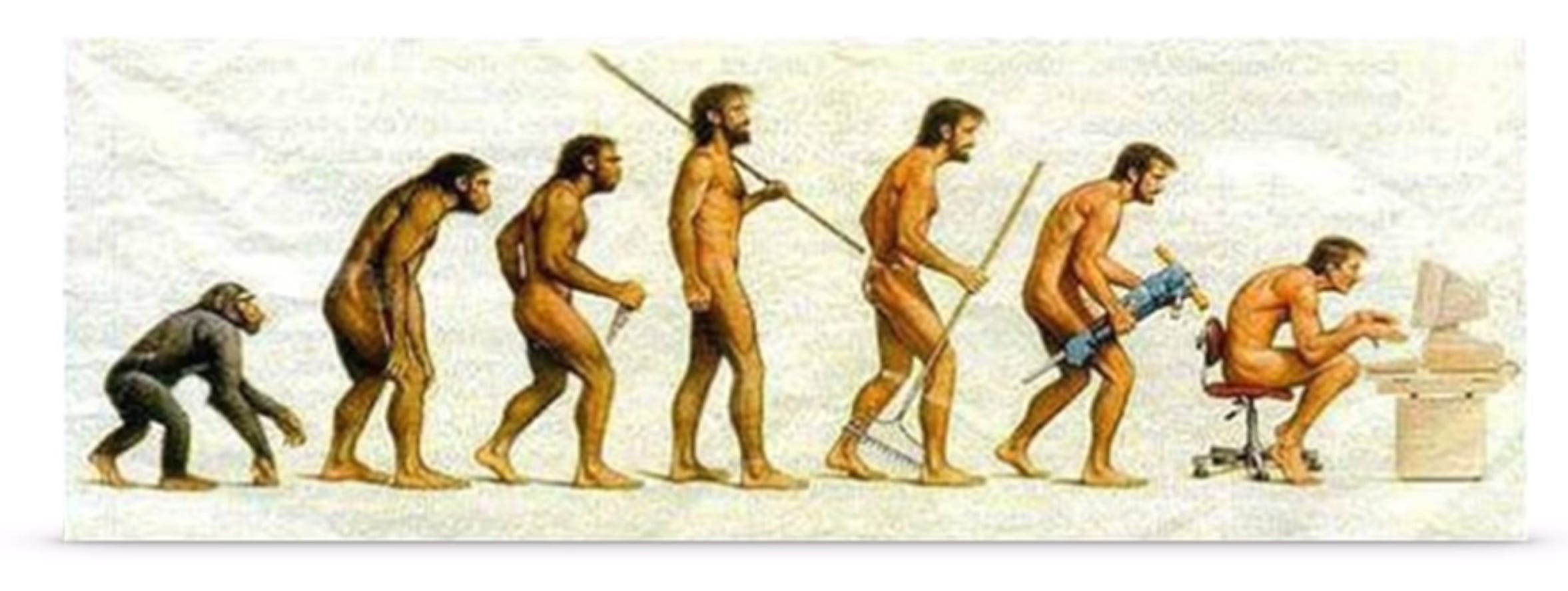
The current shape of computers is an accident of history. Computers are relics of the Literate Age when books ran the show. There were good reasons for the dominance of books. For years, words on a page were the best way to spread ideas across space and time.
Unfortunately, we’ve regressed. When it comes to activating the body, computers are even worse than books. You can hold a book. You can feel the pages and touch the dry ink. Better yet, when you’re working with pen and paper, you can move freely between drawing and writing because the pen and paper don’t care which one you pick.
As musician Brian Eno said:
"What's pissing me off is that [computers use] so little of my body. You're just sitting there, and it's quite boring. You've got this stupid little mouse that requires one hand, and your eyes. That's it. What about the rest of you? It's imprisoning. So, we need to make whole-body computers that get the heart pumping, through which we can dance out text and pictures and messages? Why haven't we done that yet?”
The only way to interact with a computer is with a keyboard, and keyboards restrict us to manipulating symbols such as letters and numbers. Bret Victor, whose doing the best work on the relationship between tools and thought, said:
“This is the cage that we have trapped ourselves in. This is the way that we have constrained our range of experience, which we have created a tiny subset of our intellectual abilities and have forbidden ourselves to use our full intellect."
A quick aside: I wonder how much Descartes’ theory of mind-body dualism from the 1600s has influenced the current shape of computing. Basically… Descartes said the mind and body were distinct and separate. He equated intelligence with the mind, not the body. In that way, by activating the mind but suppressing the body, books and computers are a reflection of mind-body dualism.
And yet, many creatives have transcended the intellectual constraints of mind-body dualism. For example, Albert Einstein and Richard Feynman famously used physical movements to aid abstract thoughts. As James Gleick wrote:
“[Physicists] found they needed imagery…a style of thinking based on a kind of seeing and feeling. That was what physical intuition meant. Feynman said to Dyson, and Dyson agreed, that Einstein’s great work had sprung from physical intuition and that when Einstein stopped creating it was because ‘he stopped thinking in concrete physical images and became a manipulator of equations.’ Intuition was not just visual but also auditory and kinesthetic. Those who watched Feynman in moments of intense concentration came away with a strong, even disturbing sense of the physicality of the process, as though his brain did not stop with the grey matter, but extended through every muscle in his body.”
Here’s the good news: Recent technological breakthroughs have unlocked new ways of spreading knowledge and processing information. With enough productive effort, we can build computers that draw on our full range of physical and intellectual capabilities.
Right now, we’re inventing the Dynamic Medium — the next medium of thought after the printing press. Computers can make us active. Shifts in technology can re-integrate the mind and body. Armed with dynamic methods of computing, we can create new forms of knowledge work which activate both body and mind.
I dream of a future where computers encourage mobility, integrate the mind with the body, promote physical health, and accelerate intellectual progress.
Fresh Ideas
North Star Podcast: Alex Danco
Alex Danco is one of my favorite writers. He’s on the Discover Team at Social Capital, a venture capital firm based in Silicon Valley. At Social Capital, Alex writes a weekly column called Snippets. It’s excellent.
Here’s what we talked about:
Amazon's organizational structure, and how it differs from Google and Apple and what that means for the future of Amazon.
Technological disruption and how industries shift from scarcity to abundance, and then back to scarcity.
The history of cities, and specifically, the shift from the past when it was easier to move people than it was to move stuff, to now today when it's easier to move stuff than it is to move people. That single shift speaks volumes about the changing landscape of cities, industries, and society at large.
You can listen to the full podcast here.
And you can download a full transcript here.
Naked Brands: The Future of Basketball
In the spirit of NBA All-Star weekend, I want to re-surface this article. It explains why LeBron James went to the Los Angeles Lakers and explores the future of basketball.
Sports fans increasingly want to connect with players — not teams. That's what this essay about.
The NBA's popularity is exploding. In LeBron’s wake, we’ve entered an age where athletes express themselves, circumvent large media outlets, and connect with fans on their own terms.
You can read the full article here.
Coolest Things I Learned This Week
Love This
Well, that’s Interesting!
A 90s study showed that women preferred the scents of men whose immune systems were most different from their own immune-system genes. Evolutionarily this makes sense as, children should be healthier if their parents’ genes vary, protecting them from more pathogens.
Lessons From Charlie Munger
"The whole trick is to have a few times where you know something is better. Invest only where you have that extra knowledge."
"We tried to do less. We never thought we could get really useful information on all subjects. If we worked very hard we could find a few things where we were right - and a few things is enough.”
And because we’re talking about Charlie Munger, I’ll throw in one of my favorite quotes from his business partner, Warren Buffett:
“Price is my due diligence. The lower the price, the less due diligence is required. If you pay a good enough price, a lot can go wrong and still be right. If you buy things far below what they are worth, and you buy a group of them, you basically don’t lose money.”
Ummmmm….
Pufferfish release a toxin when they puff out that is meant to impair the attacker. This doesn’t work on Dolphins in the same way. It gets them high. So they purposely inflate them and pass them around to their dolphin friends for fun.

Promises of Micromobility
Transportation represents 28% of greenhouse gas emissions. Micromobility can shave a big chunk off of that by eating the sub-2 miles trips making up 40% of urban rides.
The new wave of transportation tends to be electric and super lightweight. Here’s why that matters:
"Internal combustion engines are only 35% efficient, losing the rest in heat. Then, only 5% of that energy go into moving the passenger — the other 95% move the car. So, the overall efficiency of a car is 0.05 * 0.35 = 1.75%. This means that for every gallon you pour into your tank, only 2 ounces are used to move you. The rest is either lost in heat or used to move your car. Compare that to electric scooters, which convert 85% of their energy into movement and weigh around 30lbs, making their overall energy efficiency over 70%. Again, car companies would kill to improve their cars’ efficiency by 10%. Here, we’re talking of a 4000% improvement.”
Source: This post by Florent Crivello is excellent.
The Future of Smartphone Cameras
Some thoughts from Benedict Evans:
Today, portrait mode is doing face detection as well as depth mapping to work out what to focus on; in the future, it will know which of the faces in the frame is your child and set the focus on them.
We are clearly well on the way to the point at which any photograph a normal consumer takes will be technically perfect. However, there’s a second step here - not just “what is this picture and how should we focus it?” but “why did you take the picture?”
Horizontal vs. Vertical Lines in Architecture
Historically humans have traditionally strived to emphasize the vertical in buildings because it is fitting to us.
Why?
Here’s a theory: In nature, good things grow upward and bad things grow sideways.

But now, buildings have more horizontal lines.

You can see the shift from vertical to horizontal lines in photos of Potsdamer Platz in Berlin. Today all cities are dominated by horizontal buildings.
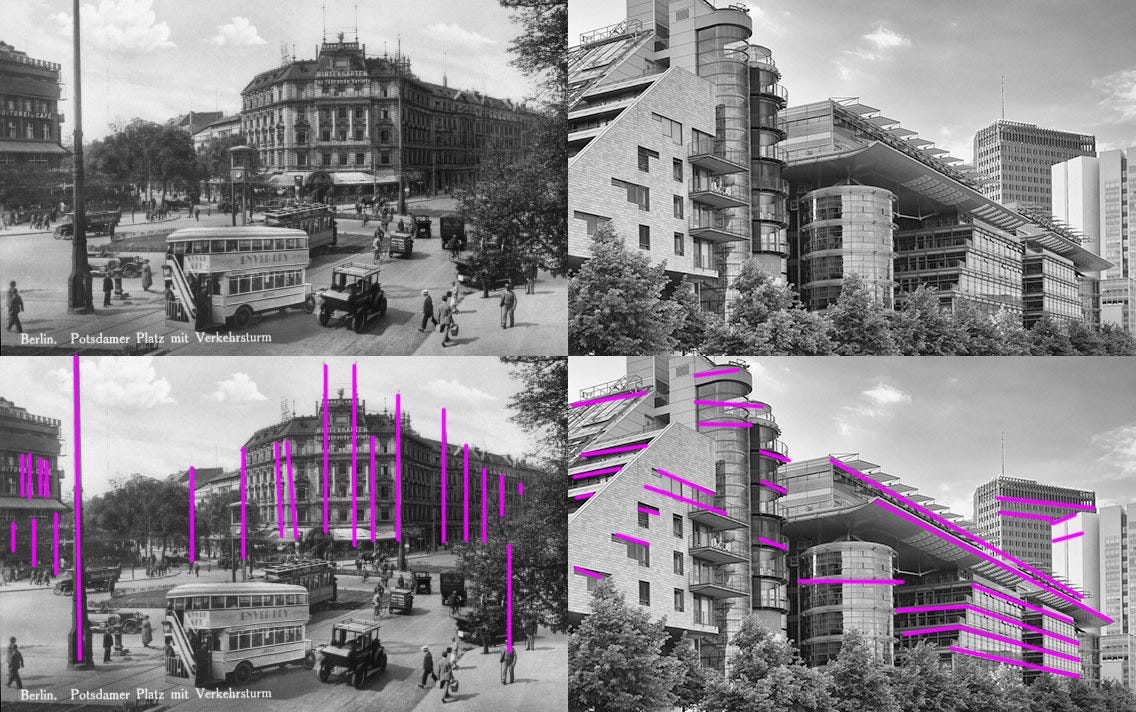
Photo of the Week

For me, the best part about the North Star Podcast is speaking with writers who’ve shaped my worldview. I’ve been reading Alex Danco’s writing for five years now.
Since he writes every week, and I read it all, I’ve read the equivalent of multiple books written by Alex. He’s one of my biggest inspirations for writing regularly, and when you listen to his clarity of thought in the interview, you’ll understand why.
His series on Understanding Abundance and Emergent Layers have influenced me most. If you’re interested in the business of technology, I can’t recommend them enough.
Enjoy the podcast and thank you for reading.
Until next week,
David Perell